


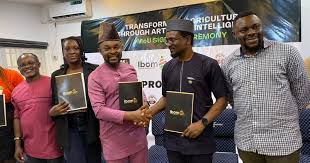
A new agricultural technology initiative is emerging from Akwa Ibom State. The Ibom Innovation Network has launched Project TAT AI, a program designed to deploy robotics and artificial intelligence across farms to reduce post-harvest losses.
The initiative represents one of Nigeria’s boldest experiments in precision agriculture, where farming decisions are driven by data, sensors, and AI systems rather than guesswork.
The Cost of Post-Harvest Losses
Nigeria loses a significant portion of its agricultural produce after harvest due to poor storage, transportation delays, and inefficient monitoring systems. 
As a result, farmers lose revenue while food prices continue rising.
Therefore, solving post-harvest losses has become just as important as increasing production itself.
What Project TAT AI Is Trying to Solve
Project TAT AI combines robotics, AI analysis, and smart monitoring systems to improve farming efficiency.
The goal is to track soil conditions, weather patterns, crop health, and supply chain movement in real time.
As a result, farmers can make faster and more accurate decisions.
The “Soil Heat Map” Strategy
One of the most important concepts behind the initiative is the soil heat map strategy.
Using sensors and AI-driven analytics, farms can identify:
- Moisture variations
- Nutrient deficiencies
- Temperature changes
- High-risk crop zones
Therefore, interventions become targeted rather than generalized.
In addition, farmers can reduce waste and optimize resource usage.
Why Precision Agriculture Matters
Traditional farming often relies on experience and manual observation.
However, AI-driven agriculture introduces predictive systems that detect problems before they become severe.
As a result, productivity improves while losses decrease.
Therefore, precision agriculture shifts farming from reactive to proactive management.
Can It Scale Beyond the South-South?
The key question is scalability.
If Project TAT AI succeeds in Akwa Ibom, similar systems could be adapted across Nigeria’s food supply chain.
Different regions have different climates and crops, but the core technology model remains transferable.
Therefore, the South-South could become a testing ground for national agricultural digitization.
The Infrastructure Challenge
Despite its promise, AI farming requires reliable infrastructure.
This includes:
- Stable internet connectivity
- Sensor networks
- Power supply systems
- Technical training for farmers
Without these, large-scale deployment becomes difficult.
Why Robotics Could Change Farming Economics
Robotics also introduces automation into labor-intensive processes.
Tasks like crop monitoring, irrigation management, and sorting can become faster and more precise.
As a result, operational costs may decline over time.
In addition, automation can improve consistency in food production.
The Bigger Picture: Food Security and Data
Project TAT AI is not just about farming, it is about data-driven food security.
The more agricultural data Nigeria collects, the better it can predict shortages, climate risks, and distribution needs.
Therefore, AI becomes a strategic tool for national planning.
Conclusion: Farming Enters the AI Era
Project TAT AI signals a major shift in Nigerian agriculture.
Instead of relying only on expansion, the focus is moving toward smarter production systems powered by robotics and AI.
Ultimately, if the Akwa Ibom model succeeds, it could become the foundation for a more efficient and resilient national food supply chain.