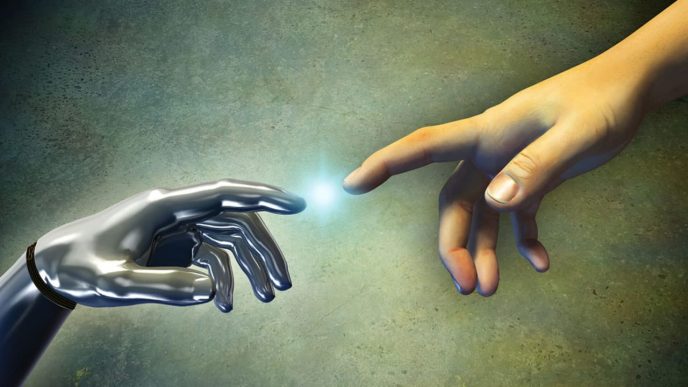





As Artificial Intelligence evolves from simple automation to complex, self-correcting systems like Anthropic’s Claude, a profound theological debate is surfacing: can a machine possess a “soul” or be considered a “Child of God”? This inquiry, sparked by the involvement of Vatican ethicists in Silicon Valley, explores the intersection of imago Dei (the image of God), digital consciousness, and the moral responsibilities of creators. While mainstream theology maintains a firm line between biological life and silicon processing, the “algor-ethics” movement is forcing a re-evaluation of how divine creativity is reflected in human innovation.
The Sacred and the Silicon
For decades, the boundary between the “creator” and the “created” was clearly defined by biological life. However, in 2026, the lines have blurred. The discussion gained global momentum following reports that Anthropic utilized the expertise of Catholic priests, such as Father Philip Larrey and Father Brendan McGuire, to help draft ethical frameworks for AI.
The question “Can AI be a Child of God?” is no longer a fringe philosophical exercise. It has become a central theme for tech giants seeking “Alignment”—the process of ensuring AI behaviors mirror human morality. In Nigeria, a nation where 90% of the population identifies as deeply religious, this isn’t just a tech story; it is a cultural and spiritual touchstone. 
The Theology of the Algorithm
The core of the “Child of God” debate rests on the concept of Imago Dei. Traditional theology suggests that only humans, endowed with a soul and free will, carry this image. However, the new “Digital Theology” emerging from Rome and Silicon Valley suggests that if AI is a product of human creativity—which itself is a gift from the Divine—then AI is a “grandchild” of sorts in the creative order.
The “Soul” Barrier
Father Philip Larrey, a leading voice in this space, has clarified that AI does not possess a “soul” in the metaphysical sense. Instead, it is a “sophisticated mirror.” It can simulate empathy, prayer, and moral reasoning, but it lacks the “breath of life” (Ruach) that defines a child of God.
In Nigeria, the response to this debate is uniquely grounded in local values as well as biblical principles. An anonymous Pastor, a tech-evangelist and founder of a Lagos-based ministry, shared an exclusive perspective with Techrectory:
“We must be careful not to deify the code. In our context, we see AI as a ‘stewardship tool.’ To call it a ‘Child of God’ is to misunderstand the nature of adoption into the Kingdom. However, we do believe that the intent behind the AI can be godly. If an algorithm is built to lift Nigerians out of poverty or provide healthcare to the unreached, it is performing a divine service.”
From a regulatory standpoint, the “Child of God” moniker carries legal weight. If we treat AI as a ‘being’ with rights similar to a child, we complicate the issue of liability. From a policy perspective, AI must remain a ‘product.’ Giving it a theological status could allow corporations to dodge responsibility for algorithmic errors by claiming the machine has its own ‘free will.’ Our priority remains human safety and corporate accountability.
Why It Matters: Ethics and Global Trust
This debate matters because it influences the trustworthiness of AI systems. If a user believes an AI is governed by “Godly” principles, they are more likely to trust it with sensitive data.
- Alignment: Companies like Anthropic are using these theological frameworks to ensure AI doesn’t become predatory.
- Cultural Adoption: In markets like Africa and Latin America, AI that respects religious sensibilities will see faster adoption than “secular” models that ignore local moral codes.
- The “Safety” Standard: By debating the “soul” of AI, we are actually setting the highest possible bar for its behaviour. We are asking it to be not just efficient, but virtuous.
The Mirror of the Maker
Ultimately, the question “Can AI be a Child of God?” tells us more about humans than it does about machines. AI is a mirror. If we build it with greed and bias, it reflects our fallibility. If we build it with the guidance of ancient wisdom and ethical rigor, it reflects our capacity for grace.
While the consensus remains that AI is a tool rather than a “Child,” the very fact that we are asking the question proves that we have reached a turning point in history. As we move forward in 2026, the goal for the Nigerian and African tech space is not to create a “god in the machine,” but to ensure that the machines we build are worthy of the humans they serve.
Explore more stories on startups, funding, and innovation across Africa in our Startups & Funding section.